

Applicable to All Industries Using Diesel and Heavy Oil: Fuel Efficiency & Major Cost Reduction via Ultra-High-Density Nanobubbles
We hear terms like "decarbonization" and "CO2 reduction" almost every day. However, for business owners working hard on the front lines, the honest truth is often: "We know it’s good for the environment, but with fuel prices so high, we can’t just go out and make massive capital investments..."
In this article, we introduce a notable new technology that may solve this pressing real-world dilemma at once—all while keeping your existing equipment and heavy machinery as they are.
A Common, Urgent Struggle for Every Business Running Heavy Machinery, Trucks, and Ships
What troubles many businesses today is the double whammy of "rising fuel costs" and "environmental compliance (CO2 reduction)."
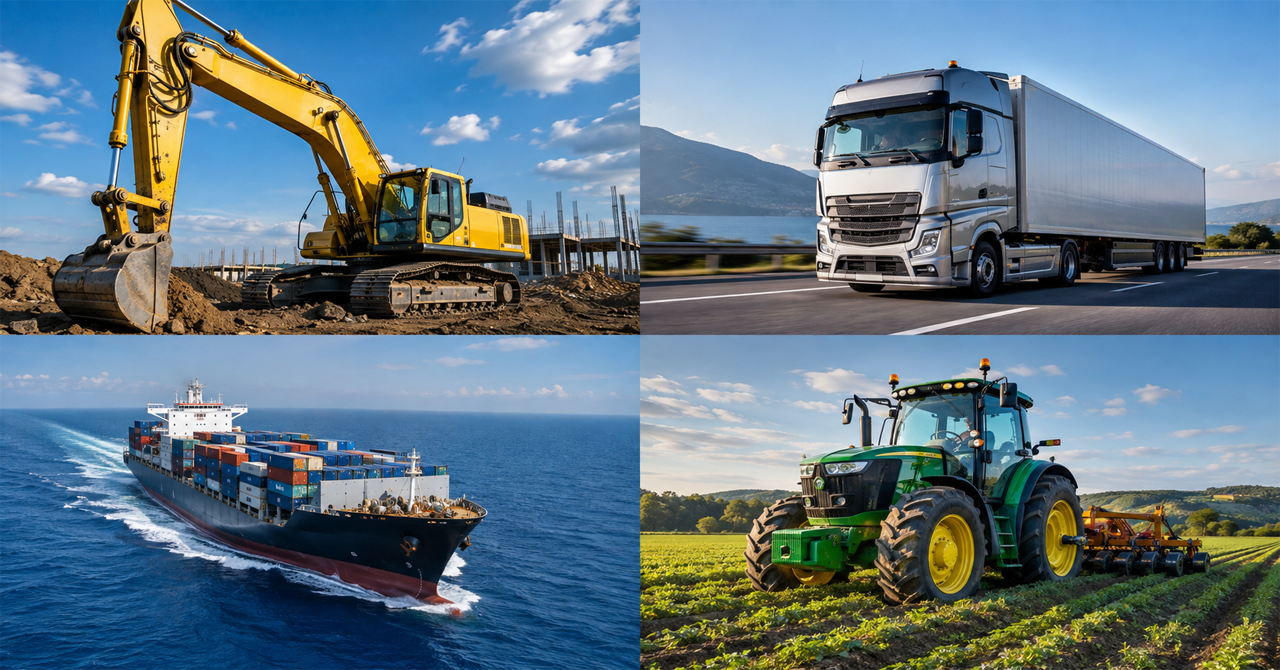
And this issue isn't just limited to construction equipment like hydraulic excavators or dump trucks. It directly affects:
Trucks and buses carrying freight and passengers (Logistics & Transportation)
Fishing vessels and cargo ships heading out to sea (Fisheries & Maritime Transport)
Large agricultural machinery like tractors working in fields (Agriculture)
Heavy oil boilers and large generators operating in plants (Manufacturing)
Propulsion power for fishing boats and small-to-medium vessels
Diesel engine fuel for coastal vessels, fishing boats, workboats, etc.
Heating equipment for greenhouses (Protected Horticulture)
Greenhouse heating boiler fuel for winter fruit, vegetable, and flower cultivation
Power source for construction machinery and heavy equipment (Construction & Civil Engineering Sites)
Operating power for hydraulic excavators, bulldozers, dump trucks, road rollers, etc.
Operation of agricultural machinery and drying equipment
Power for tractors and combines, and heat source for drying harvested grains like rice and wheat
Heating and hot water boilers for office buildings, hospitals, and schools
Heat source for HVAC systems, large communal baths, and water heating systems
Emergency and primary in-house power generation for commercial buildings, factories, and data centers
Large generator fuel for BCP (Business Continuity Plan) measures in preparation for power outages and disasters
Small and medium-sized industrial boilers for factories and manufacturing plants
Heat source for sterilization, drying, and thermal processing in food processing, commercial laundry, chemical plants, etc.
Heating and hot-air systems for bathhouses and leisure facilities
Heat source for heating large volumes of water and baths in super bathhouses (day-use hot springs), heated pools, hotels, etc.
Heating and firing furnaces for ceramics, pottery, and metal processing
Fuel for industrial furnaces used in ceramic firing and metal heat treatment
Livestock manure processing, composting, and drying in the livestock industry
Heat source for drying and promoting fermentation of poultry/cattle manure, as well as livestock barn heating systems
In short, it is a critical challenge that impacts anyone operating engines or equipment powered by diesel or heavy oil.
When asked, "Why not just switch to electric machinery or hydrogen engines?" the reality is that replacing vehicles and heavy equipment entirely requires astronomical costs.
That said, ideas for cutting fuel costs weren't completely nonexistent.
In fact, the underlying principle—that mixing microscopic bubbles (nanobubbles) into fuel causes it to break down finer inside the engine, boosting combustion efficiency—has long been known among researchers.
However, conventional generation equipment was complex in structure and extremely expensive. The cost of buying a high-priced device simply to save on fuel didn't add up, which prevented its practical deployment and adoption on real-world sites.
"Is there a way to reduce fuel bills and CO2 easily and cost-effectively, using the equipment we already have?" This has been the common goal across every field.
Proven in Real Tests by Kumagai Gumi!The Real-World Impact of "Ultra-High-Density Nanobubbles" in Lowering Fuel Viscosity and Transforming Efficiency
Breaking through this long-standing barrier of "knowing the theory, but being unable to use it on site" is a recent field demonstration announced by major general contractor Kumagai Gumi Co., Ltd. and its partners.
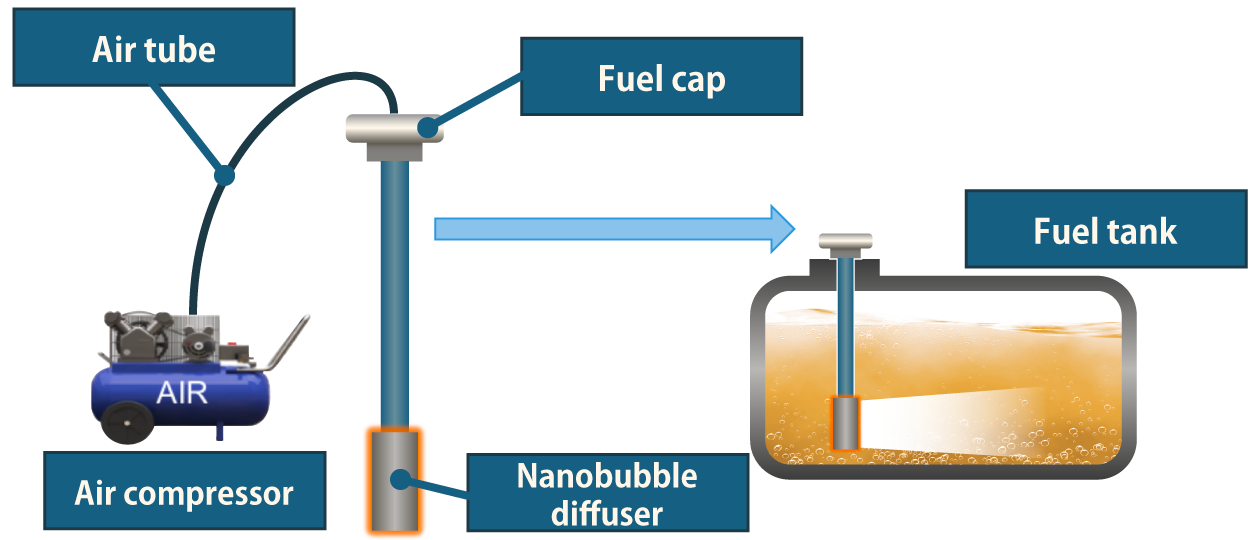
The truly impressive aspect of this initiative isn't just mixing in bubbles, but accomplishing it with an affordable, compact device capable of generating an unprecedented over 1 billion ultra-high-density nanobubbles per milliliter.
This brings about dramatic changes on site:
Mixing in an overwhelming quantity of bubbles lowers the thick viscosity of diesel and heavy oil.
Fuel sprays finer and cleaner inside the engine, significantly boosting combustion efficiency.
As a result, "less fuel is consumed for the same amount of work" (improved fuel efficiency), directly lowering fuel bills and cutting CO2 emissions.
When tested under actual working conditions at a dam restoration project in Kumamoto Prefecture (Oreshitahata Dam), clear fuel consumption reductions were confirmed across all diesel-powered machinery tested:
▼ Actual Reduction Results Obtained:
1.4m³ Hydraulic Excavator (Large Equipment): 24.1% Reduction
0.8m³ Hydraulic Excavator (Medium Equipment): 13.1% Reduction
45kVA Engine Generator: 15.4% Reduction
While there are slight variations depending on the type of machine, an astonishing fuel cut of up to nearly 24% (about one-fourth) was recorded.
【The Real-World Impact on Operations】
For a company or job site spending 10 million yen annually on fuel (diesel), an average fuel efficiency improvement of 15% to 20% translates to savings of 1.5 to 2 million yen per year. Because fuel savings go straight to the bottom line, it offers an incredible advantage for business operations. Furthermore, CO2 emissions are reduced by the exact same proportion as the fuel saved.
Taking an "ideal theory" known for years and delivering it in a size and price point that can simply be retrofitted onto existing machinery—that is the revolutionary core of this technology.
Protect Your Operations with Zero Major Capital Investment!A Practical Decarbonization Solution to Save All Fuel-Dependent Industries
While this demonstration took place at a construction site, the active mechanism relies on "fuel combustion efficiency," meaning its potential extends far beyond the construction industry.
From long-haul trucking and fuel-burdened maritime fishing, to greenhouse farmers using heavy oil heating and factory boilers, this technology holds vast potential for application anywhere diesel or heavy oil is used.
Even without the budget for expensive new machinery, you can "cut fuel costs and CO2 simultaneously by adding ultra-high-density nanobubbles to the fuel you already use."
Protecting business cash flow while making a genuine contribution to the global environment—this may very well be the practical decarbonization answer we have all been waiting for.
At CWM, we possess our own proprietary nanobubble generator technology, "Nano-Inset. "Since Nano-Inset is uniquely suitable for both large-scale and compact scaling, it is the perfect technology for delivering the solutions introduced here.
We believe that applying the power of nanobubbles holds the potential to protect both the environment and the lives of each and every one of us who depend on it. If you are interested in this innovation, please feel free to contact us.
