

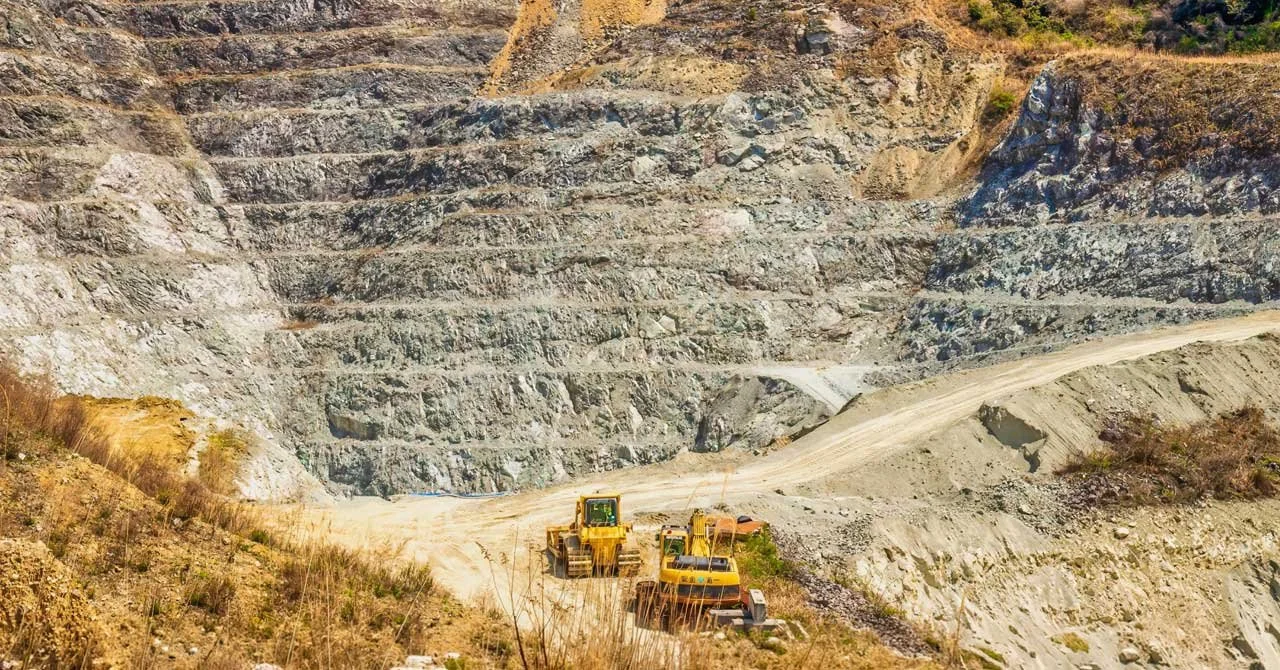
1. Structural Challenges of Mining "Haul Roads" and the Strategic Importance of Improvement
In mining operations, the maintenance of haul roads is a critical management issue that transcends mere site maintenance.
The condition of these "arteries of the site," where heavy machinery constantly travels, directly impacts the optimization of haul cycle times, fuel consumption (rolling resistance), and the wear costs of tires for ultra-heavy vehicles, ultimately dictating the productivity and cash flow of the entire operation.
However, haul roads at mining sites face three structural constraints that are fundamentally different from general civil engineering roads.
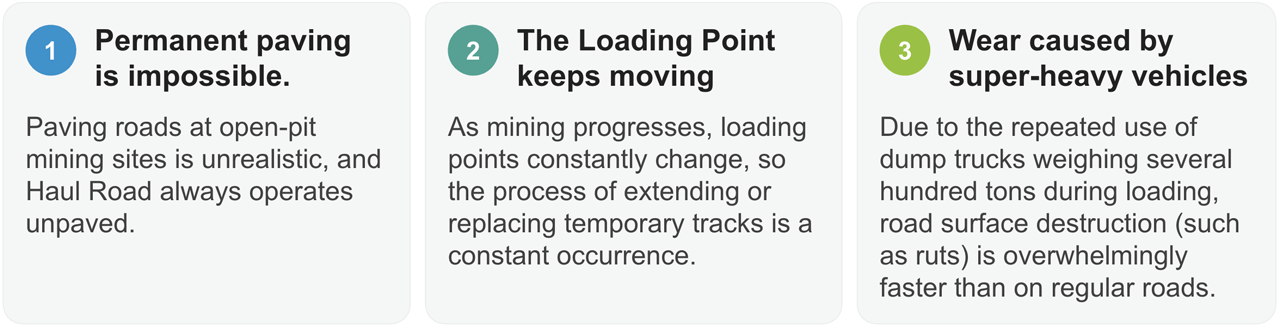
Impossibility of Permanent Paving: Asphalting vast open-pit sites is cost-prohibitive, forcing operations to remain on "unpaved" surfaces.
Continuous Movement of Loading Points: As mining progresses, roads must be extended and rerouted, making fixed infrastructure investment impractical.
Severe Wear from Ultra-Heavy Vehicles: Because hundreds-of-tons-class dump trucks repeatedly pass through, the rate of road surface destruction (such as rutting) is incomparable to general roads.
Due to these three constraints, the market has consistently demanded conditions of "low cost, repeatable construction, and utilization of local soil."
However, previous countermeasures have been merely temporary "band-aids" and have not led to fundamental solutions.
2. Why Existing Stabilizers Struggle with Lifecycle Costs and Fall into Price Competition
Current mainstream stabilizers are broadly classified into three types.
However, they are bound by a single revenue structure of "selling materials," trapping them in a "commodity trap" where differentiation of added value is difficult.
Comparison of Major Existing Methods and Nano-Inset™
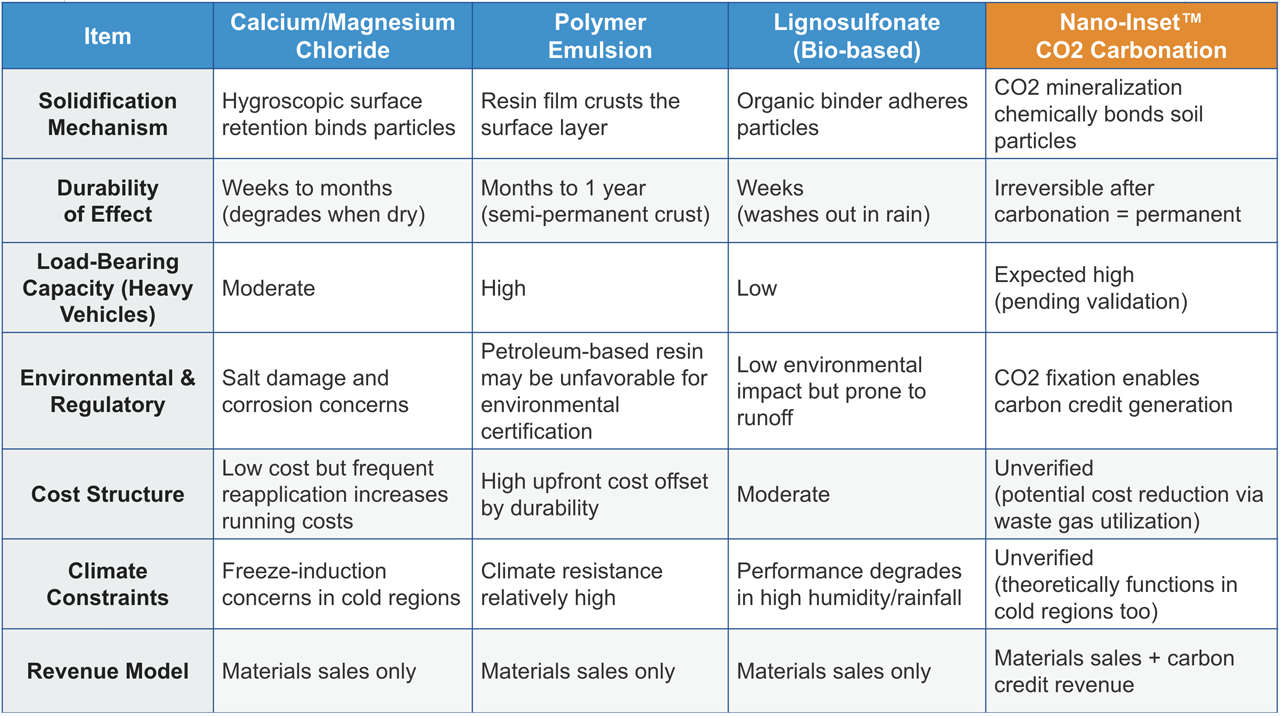
Calcium/Magnesium Chloride
Environment/Regulations: Concerns regarding salt damage and corrosion.
Cost Structure: Inexpensive, but high re-application frequency leads to increased running costs.
Climate Constraints: Risk of inducing freezing in cold regions.
Revenue Model: Sales of materials only.
Polymer Emulsion
Environment/Regulations: May be disadvantageous for environmental certification due to the use of petroleum-derived resins.
Cost Structure: High initial costs, but offset by durability.
Climate Constraints: Relatively high climate resistance.
Revenue Model: Sales of materials only.
Lignosulfonate (Bio-based)
Environment/Regulations: Low environmental impact, but components are easily washed away.
Cost Structure: Moderate.
Climate Constraints: Concerns regarding performance degradation due to high humidity or rainfall.
Revenue Model: Sales of materials only.
Nano-Inset™ (CO2 Carbonation)
Environment/Regulations: Potential for carbon credit conversion through CO2 fixation.
Cost Structure: Potential for cost reduction by utilizing industrial waste gas (under validation).
Climate Constraints: Theoretically functional in cold regions (under validation).
Revenue Model: Dual model—sales of materials plus carbon credit revenue.
Limitations of Existing Businesses
Existing stabilizer manufacturers are forced to compete solely on lifecycle costs—how to make it cheap and long-lasting.
For customers, it is merely an "OpEx" (maintenance cost), creating a structure where essential technological innovation is difficult to occur amidst intensifying price competition.
Nano-Inset™ is the solution that breaks this stagnant market and transforms maintenance costs into a "strategic asset."
3. "Permanent Solidification" and "Dual Revenue Model" through CO2 Mineralization
The innovation of Nano-Inset™ lies in a chemical approach of "mineralization" using CO2, rather than conventional physical bonding.
Strategic Advantages and Management Impact
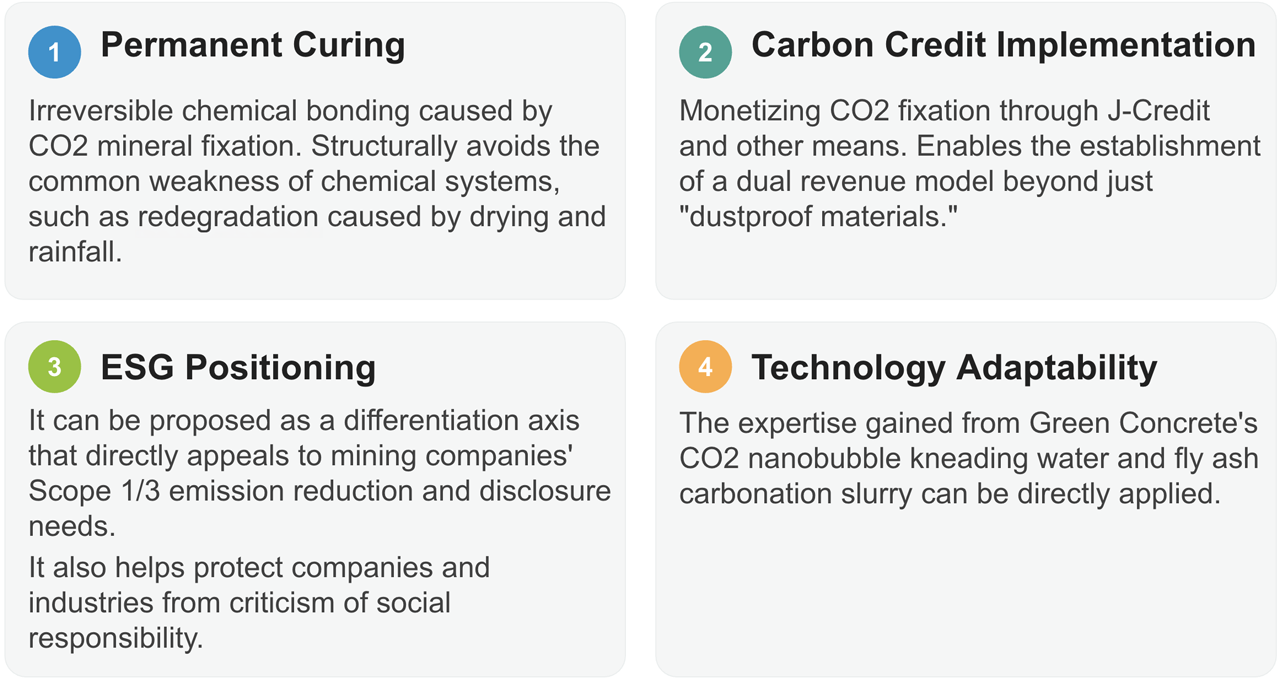

Maintenance-Free via Permanent Solidification: Mineral fixation of CO2 is an irreversible reaction.
It structurally overcomes the weaknesses of existing technologies, such as re-deterioration due to drying or rainfall, achieving a dramatic improvement in road surface strength and a reduction in repair frequency.Shift from "Maintenance Cost" to "Carbon Asset": By utilizing systems like J-Credit, the amount of CO2 fixed on the road surface can be monetized.
As of May 2026, the reference unit price for J-Credits is approximately 4,300–6,000 JPY/t-CO2, and this upward trend serves as a strong tailwind for credit revenue.
This allows for shifting the evaluation on the balance sheet from "mere cost" to "revenue-generating asset."ESG Positioning and Scope 3 Compliance: It becomes a "differentiation axis" that directly meets the needs of mining companies for Scope 1/3 emission reduction and disclosure.
This serves as a powerful strategic weapon to protect companies from criticism regarding environmental impact from investors and society.Technological Transferability and Reliability: It applies knowledge gained from the "Green Concrete" project, such as CO2 nanobubble water and fly ash carbonation, as is.
Having an established technological foundation enhances the certainty of implementation.
4. Roadmap to Practical Application and Risk Management Strategy
Sincere management of uncertainty is essential for the social implementation of new technologies. Nano-Inset™ will resolve the following three issues in stages.
Response Policy to Unverified Matters
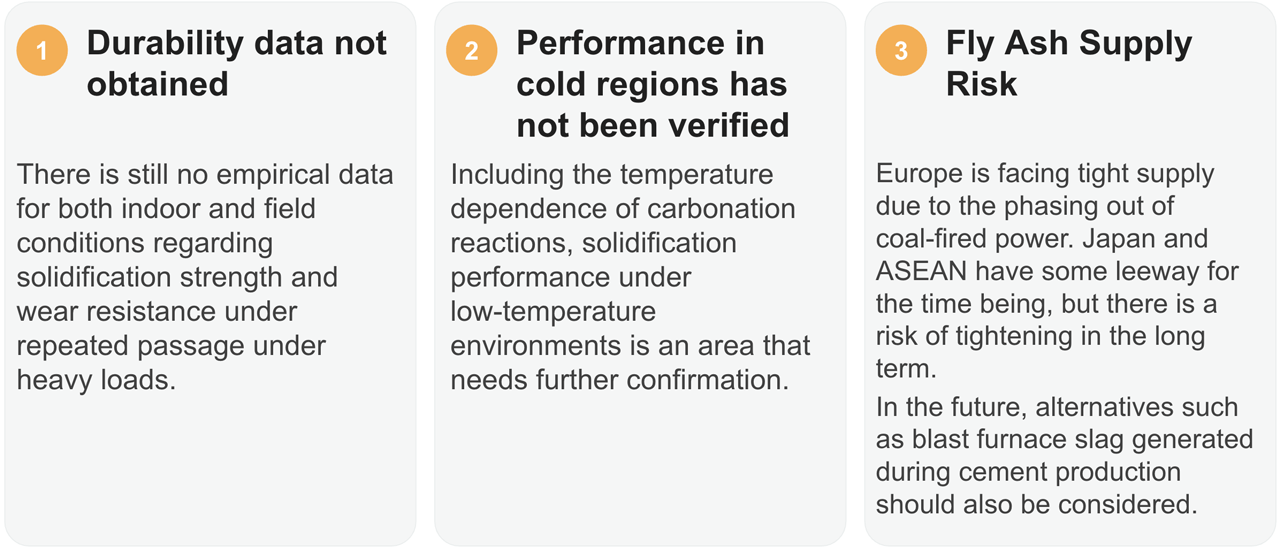
Durability and Load-Bearing Data: Wear resistance under hundreds-of-tons-class ultra-heavy vehicles will be quantitatively measured through future indoor and field demonstrations.
Climate Constraints: We will verify the temperature dependence of the carbonation reaction, proving its superiority in cold regions where chloride-based agents struggle.
Raw Material Supply Risk (Tightening of Fly Ash): To address the supply risk of fly ash associated with the phase-out of coal-fired power, we position the "CO2 Nanobubble Mixing Method" as our core technology. By situating fly ash carbonation as a "high value-added option," we have completed risk hedging against future raw material shortages.
Implementation Roadmap: 3 Phases Toward Commercialization
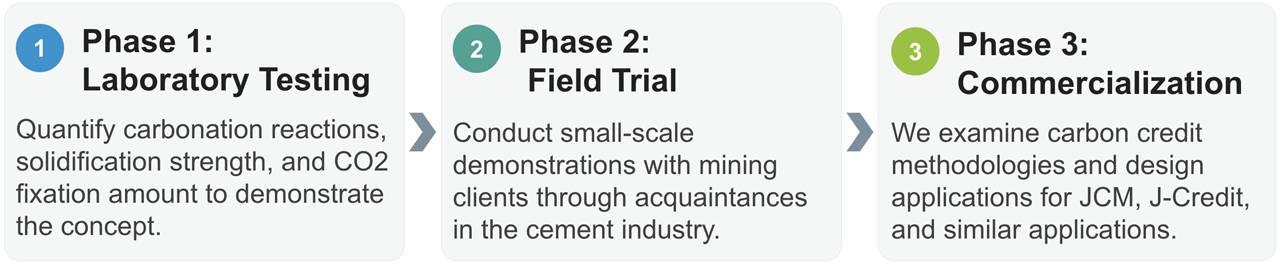
Indoor Testing: Quantify carbonation reaction, solidification strength, and CO2 fixation to verify the concept.
Field Trials: Conduct small-scale demonstration construction at actual mining sites.
Commercialization: Complete the study of carbon credit methodologies and design applications for JCM, J-Credit, etc., aiming for actual monetization. By progressing stage-by-stage from "proof of concept to credit creation," we maximize return on investment and promote secure social implementation.
While we are prioritizing verification for 'mining haul roads,' where environments are the most severe, this technology holds significant potential for future application and expansion into all types of unpaved roads in social infrastructure, such as temporary construction site roads, agricultural roads, and forest roads.
5. A New Standard for Sustainable Mining Development
Until now, the stabilization of mining haul roads has been treated as "unavoidable maintenance costs" that cut into profits. However, Nano-Inset™ dramatically transforms these costs into "investments that generate environmental value." It fixes CO2 as a resource into the road surface, creating resilient infrastructure while generating carbon credits.
This model symbolizes "next-generation mine management" where economic benefits and social responsibility (ESG) do not conflict but enhance each other.
Please pay attention to the opportunities brought by this "change from the ground up" so that the mining industry can continue to play a crucial role in a decarbonized society.
We are redefining the future of mining development through the redefinition of haul roads.
