

Giant Ships Gliding on Bubbles?The "Air Lubrication System": An Energy-Saving Tech Revolutionizing the Shipping Industry
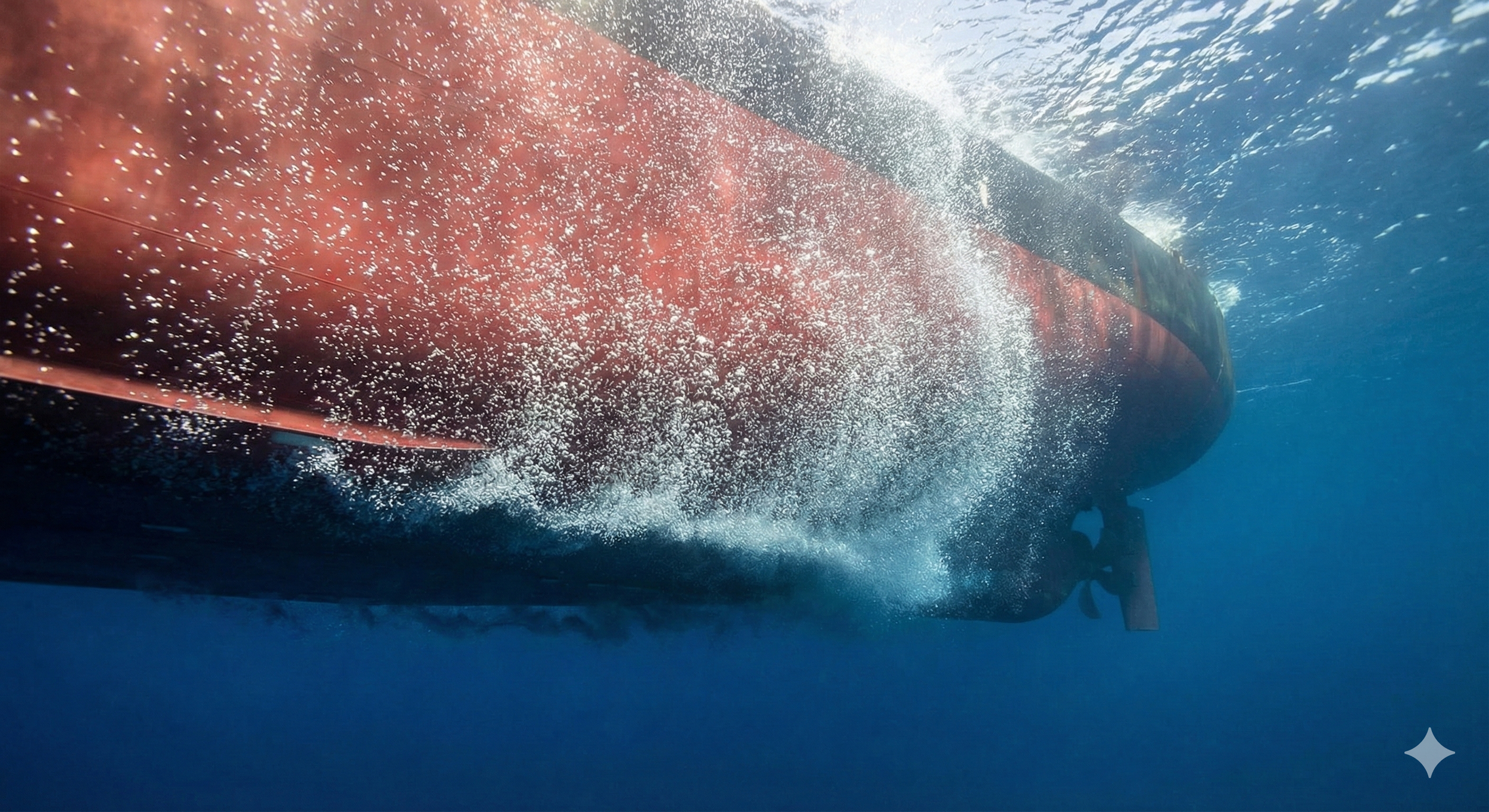
Most of the goods that support our daily lives arrive across the sea on massive ships. However, propelling these colossal iron vessels through the water requires enormous amounts of energy.
Now, in a shipping industry where decarbonization is urgently demanded, a surprising technology using "bubbles" is gaining attention.
In this article, we will explain the "Air Lubrication System (ALS)," which dramatically improves fuel efficiency by enveloping the ship's bottom in air, and its evolutionary successor, "Nano-bubble" technology.
1. The Biggest Enemy of Fuel Efficiency: "Water Friction"
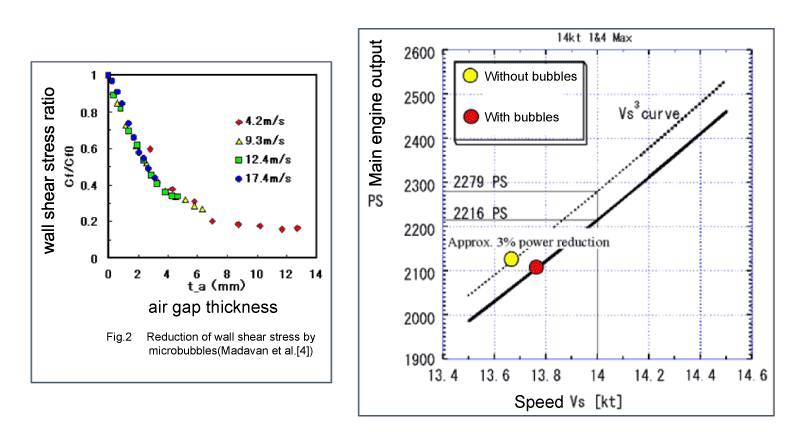
When a ship moves through the sea, what robs the engine of much of its power is the "frictional resistance" generated between the water and the hull.
Since water is far denser and more viscous than air, it acts as a massive brake on the ship.
To combat this, the "Air Lubrication System (ALS)" was developed.
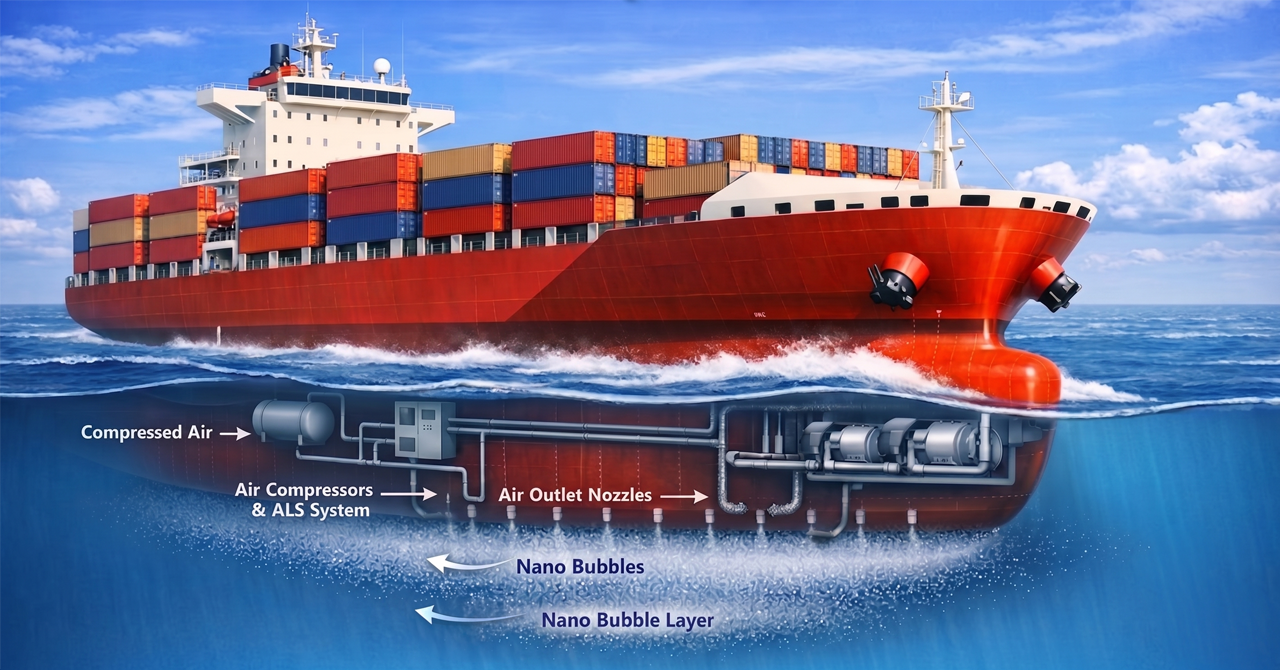
This technology releases air from the ship's bottom to lay an "air carpet" between the hull and the seawater.
Why do "bubbles" reduce friction?
Density Reduction
By interposing air, which has a significantly lower density than water, the amount of water directly touching the hull is physically reduced.Viscosity Reduction
The layer of air acts like a lubricant, allowing the ship to "glide" over the water.Turbulence Suppression
Turbulence (eddies) generated near the hull causes resistance.
Research shows that micro-bubbles act as a cushion, suppressing this turbulence.
2. The Key to the Next Generation: "Nano-bubbles"
While conventional air lubrication systems are effective, methods using invisible "Nano-bubbles" or "Micro-bubbles" are recently attracting intense interest as a next-generation technology.
What makes Nano-bubbles so amazing?
Hard to Rise (Long-lasting Effect)
Large bubbles have strong buoyancy and quickly escape to the sea surface.
However, nano-bubbles (less than 1 micrometer in diameter) have extremely low buoyancy.
This allows them to cling to the ship's bottom and remain there for a long time, making it possible to cover the hull with a film of air all the way to the stern.
High Effectiveness with Less Air
The smaller the bubbles, the more drastically their total surface area increases.
This allows for efficient coverage of the hull with less energy (air supply).
3. Not "Just 5%": An Economic Effect Worth Billions in the Shipping Industry
The fuel reduction effect of this technology is estimated to be around 5% to 10%.
You might think, "Is that all?" However, in the world of giant ships, the meaning of this number is on a different level. This is because the scale of energy handled is "monster-class."
① The Scale of Money: Savings of "Tens of Millions of Yen" per Ship
Large container ships and tankers can consume over 100 tons of fuel in a single day. Converting this to monetary value, fuel costs alone amount to billions of yen annually. Let's apply the "5–10%" reduction effect here.
Estimated Savings: A cost cut of tens of millions to over 100 million yen per year for a single ship.
If applied to all the dozens or hundreds of ships a company owns, the impact is significant enough to transform the company's entire profit structure.
② Environmental Impact: Eliminating "Thousands of Cars" per Ship
The CO2 emissions of a single large ship are said to be equivalent to thousands or even tens of thousands of passenger cars.
In other words, reducing emissions by 5–10% for just one ship makes an environmental contribution equivalent to "removing hundreds to thousands of cars from the road (or switching them to EVs)."
Introducing this technology to just one ship has an effect comparable to eliminating the exhaust gas of an entire town.
This is the true weight of "5%" in the shipping industry.
4. Already at Sea! Real-World Applications
This technology is not just a laboratory experiment. Practical application is already advancing, led by major Japanese companies.
Mitsubishi Heavy Industries "MALS"
Specifically designed blowers send air to the ship's bottom to create a carpet of bubbles.
It has a track record of adoption in ferries and module carriers.Mitsui O.S.K. Lines / IHI
Conducting experiments using micro-bubbles on large ferries and tankers since the early 2000s, verifying the effects from an early stage.NYK (Nippon Yusen Kaisha)
Installed on pure car carriers and other vessels.
It is being adopted for new ships as one of the pillars of their strategic technology for CO2 reduction.
5. Nano-bubbles Mixed in Fuel
So far, we have discussed the "outside of the ship," but technology is also being developed to mix nano-bubbles into the "fuel itself."
By infusing fuel (such as heavy oil) with nano-sized air or water, the fuel atomizes more easily within the engine cylinders and mixes better with oxygen.
This brings the process closer to complete combustion, realizing both improved fuel efficiency and a reduction in soot simultaneously.
6. CWM's Proprietary Technology "Nano-Inset": A Dual Approach to Energy Saving and Ocean Purification
While we have explained the general technology trends so far, CWM possesses unique technology and a vision that sets us apart in this field.
1. Retrofit Ready! The Strengths of "Nano-Inset"
CWM's proprietary nano-bubble generator technology, "Nano-Inset," is a groundbreaking innovation that operates on ultra-low power and can be freely scaled up or down. Its greatest feature is its compactness. It can be installed not only on new ships but can also be retrofitted to existing vessels. This makes it possible to evolve ships currently sailing around the world into "energy-saving ships" at a low cost.
2. Returning Oxygen to the Sea: The Challenge of "Nature Positive"
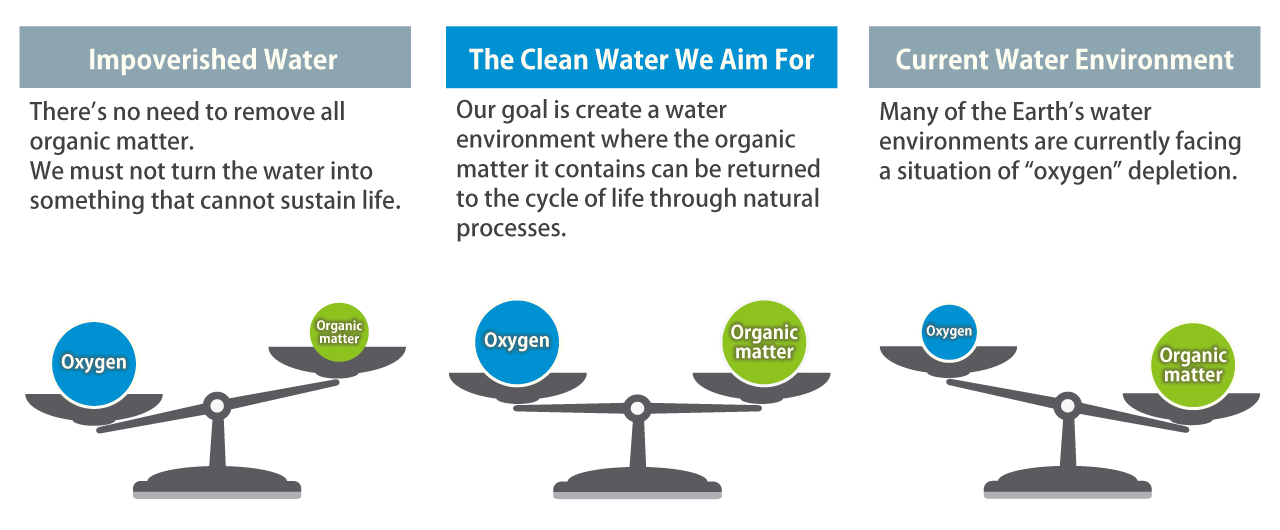
The true value of the "Nano-Inset" air lubrication system is not just energy conservation (fuel efficiency). Due to greenhouse gases and high-concentration wastewater, modern oceans are becoming increasingly polluted, leading to a serious issue of "hypoxia" (oxygen depletion). This imbalance in oxygen levels is one of the fundamental causes of global environmental deterioration.
Our system injects large amounts of air into the water. It efficiently dissolves the roughly 20% oxygen contained in that air into the seawater in the form of nano-bubbles.
Carbon Offset: CO2 reduction through improved fuel efficiency.
Nature Positive: Supplying oxygen to the sea to restore marine richness.
If ships around the world are equipped with this system, the act of moving across the ocean will directly lead to "purifying the ocean." That is the future we aim to realize.
7. Transformation Over Profit: CWM Business Model
Another surprising advantage of "Nano-Inset" is its extremely low introduction cost. This is not simply because production costs are low. It is because CWM does not aim to make a large profit from selling the hardware itself.
Our true goal is to scientifically verify the effects of this technology and establish a business model based on the resulting Carbon Credits.
To turn the "incentive for clean water" into a reality, we prioritize widespread adoption over hardware profits.
Summary: Call for Partners
Nano-bubble and micro-bubble technologies, along with Air Lubrication Systems (ALS), serve as ultimate solutions to simultaneously achieve energy efficiency and marine ecosystem restoration in the maritime industry.
In the coming era, environmental measures will transition from simply "mitigating environmental burdens (decarbonization)" toward "actively regenerating and revitalizing the global environment (nature-positive)."
CWM’s "Nano-Inset" represents a visionary technology that shapes this future, enabling oceans to be purified through the very act of shipping.CWM is currently looking for business partners to bring about significant social change together using this "Nano-Inset" technology. If you are interested in creating new value through contribution to the global environment and carbon credits, rather than just hardware sales, please feel free to contact us.
