

[Infrastructure Shift] From "Processing Facilities" to"Generating Facilities": A Carbon-Neutral Future Envisioned byWastewater Treatment Plants × Nanobubbles
1. We Can Protect "Clean Water" but Not "Energy": The Dilemma of
Modern Infrastructure
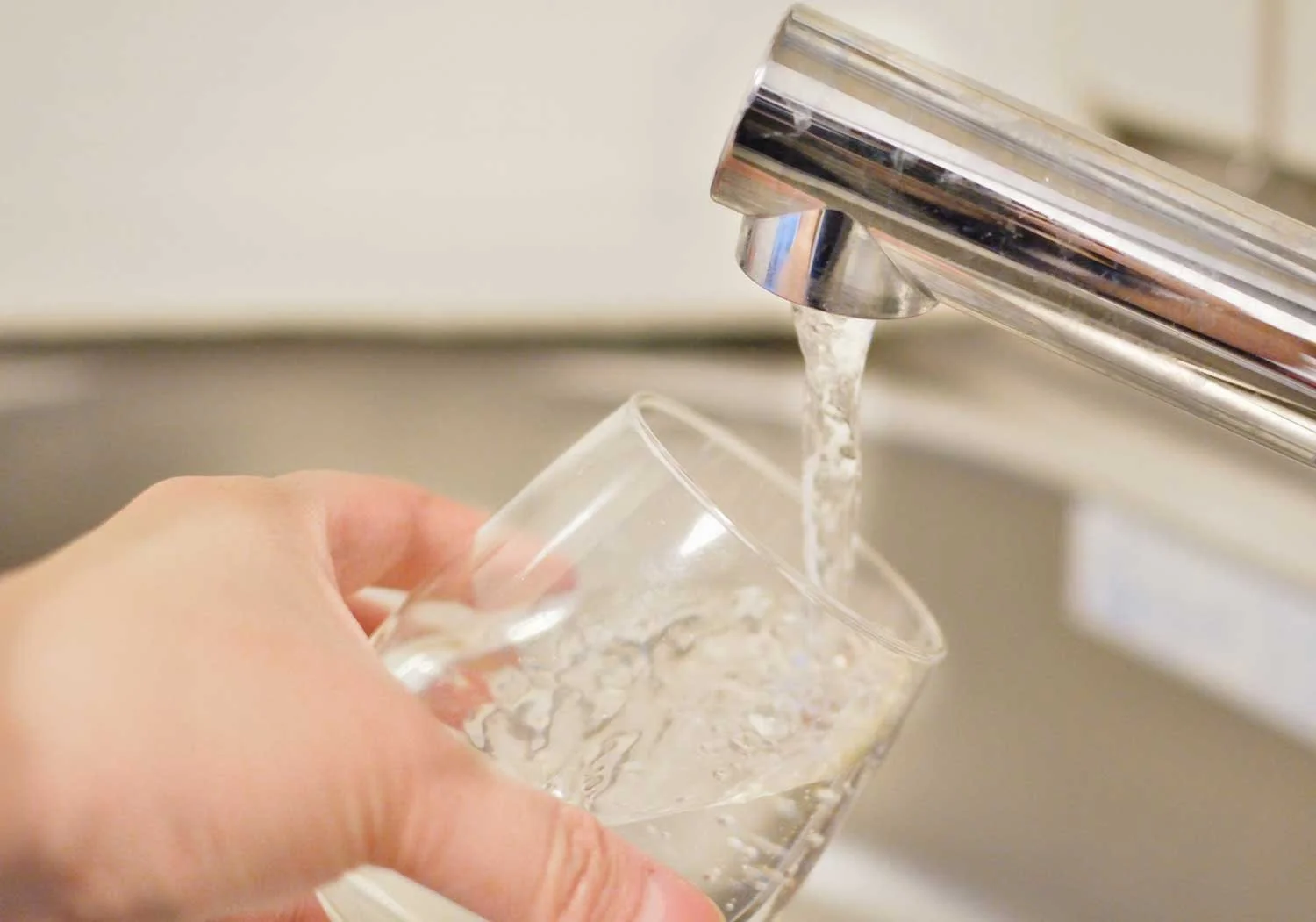
Consider the domestic wastewater we discharge without a second thought. Japan’s sewage system coverage is high, and the cleanliness of our rivers and oceans is among the best in the world.
However, are you aware of the invisible price paid to maintain this "cleanliness"?
Maintaining Water Quality: Through advanced treatment technologies,sewage is purified and returned to the natural world in a safe state.
This is a great success for public health.
Wasting Energy: The heart of this purification process is "aeration"(supplying oxygen to microorganisms).
This single process consumes a massive amount of energy approximately 30% to 50% of the total electricity used by a wastewater treatment plant.
Furthermore, the incineration and disposal of large quantities of "sludge" generated during the treatment process entail significant costs and CO2 emissions.
In short, the current system faces a contradiction: "We are polluting the Earth (energy and environment) to clean the water."
We aim to resolve this structural contradiction and transform wastewater treatment plants from energy-consuming facilities into sustainable,circular hubs.
2. The "Quality" of Bubbles Changes Efficiency: Optimizing Oxygen
Supply with Nanobubbles
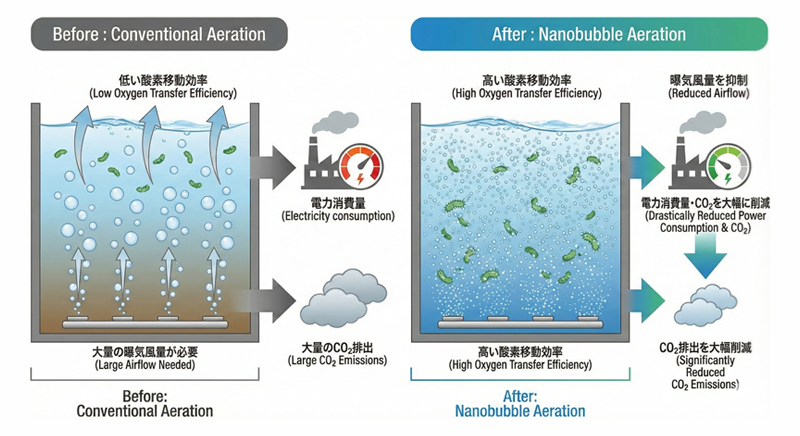
For microorganisms to decompose pollutants, "oxygen" is essential.
However, with conventional methods, the majority of the air pumped ingoes to waste.
Nanobubble Retention Power: Conventional large bubbles (milli-bubbles) quickly rise to the water surface due to buoyancy and burst.
In contrast, nanobubbles have extremely low buoyancy and remain suspended in the water for long periods. This makes it possible to deliver the oxygen microorganisms need, exactly "where it is needed" and "in the amount needed," dramatically improving Gas Transfer Efficiency (GTE).
The Deciding Factor for "Significant Reductions" in Power and CO2:
This dramatic improvement in oxygen transfer efficiency is directly linked to a "massive reduction in power consumption and CO2 emissions."
If microorganisms can use oxygen efficiently, the output of the massive blowers—which previously operated at full capacity to pump in large volumes of air—can be significantly reduced.
Slimming down the largest energy consumer in wastewater treatment plants is a concrete measure with tremendous impact toward achieving carbon neutrality for municipalities.
Building a Mechanism to Measure "Reduction Effects":
We envision building a system that allows for real-time monitoring of the "aeration airflow reduction rate (electricity reduction)" and the "surplus sludge suppression volume" resulting from the introduction of nanobubbles.
By developing technology to quantify process efficiency and "visualize" the contribution to CO2 reduction, this data can serve as proof of municipal decarbonization. We aim to realize an ideal operational model where the generated profits are reinvested into measures against aging infrastructure.
3. "Co-creation" Among Government, Industry, and Academia is the Key
to Success: Toward the Standardization of Green Infrastructure

Revamping sewage infrastructure is not something that can be achieved by the efforts of a single company or municipality alone. It requires laws, regulations, technical standards, and the understanding of the local community.
Collaboration with Academic and Research Institutions: Analysis of the impact of nanobubbles on the microbiome, and the elucidation and academic validation of mechanisms for suppressing greenhouse gases(such as N2O).
Collaboration with Municipalities and Government Agencies: Provision of demonstration fields using actual treatment plants, and the review
and formulation of bidding requirements and guidelines (participation in the B-DASH Project, etc.) for the introduction of new technologies.
Collaboration with Plant Manufacturers and Engineering Firms: Joint development of highly versatile nanobubble generators that can be retrofitted to existing diffusers and aeration tanks, along with the establishment of maintenance systems.
Collaboration with Financial Institutions and Investors: Establishment of finance schemes to evaluate energy-saving and sludge-reduction effects as "environmental value," making them eligible for Green Bonds and ESG investments.
Just as forests were once recognized for their value as CO2 sinks, wastewater treatment plants will evolve into "Fortresses of Decarbonization" through nanobubble technology. Let us rebuild a sustainable future starting from the infrastructure that supports our daily lives beneath our feet.
CWM has patented original technology "Nano-Incet" which is highly capable in this medical solution as well, and looking for business partners.
If you are interested in this solution, no hesitation is needed to contact us to make a big change to society together.
