

"No Supplies?" How to Maintain Sanitation When it Matters Most. "OzoneWater," Created from Water and Air, is a Game-Changer for RemoteMedicine.
In Japan, a country prone to natural disasters like earthquakes and typhoons, one of the biggest challenges we face is "medical care and sanitation management during disasters."
In evacuation centers or isolated areas where transportation has been cut off, the real fear isn't just the immediate injuries sustained during the disaster, but the "spread of infectious diseases due to deteriorating sanitary conditions" that follows.
Shortages of disinfectants, lack of water for washing, and insufficient medical personnel—in these extreme conditions, a new technology is revolutionizing medical standards:Free-Radicalized Ozone Water.
In this article, based on comparative data with existing disinfectants, we will unravel why this technology is being called the "savior" of disaster relief and remote medicine.
1.Is it Possible to "Differentiate" Disinfectants in a Disaster Zone?
Normally, hospitals and medical facilities strictly differentiatevarious disinfectants based on their intended use.
However, enforcing this in a chaotic disaster site or an environment without specialists is not easy.
First, please look at this comparison table.
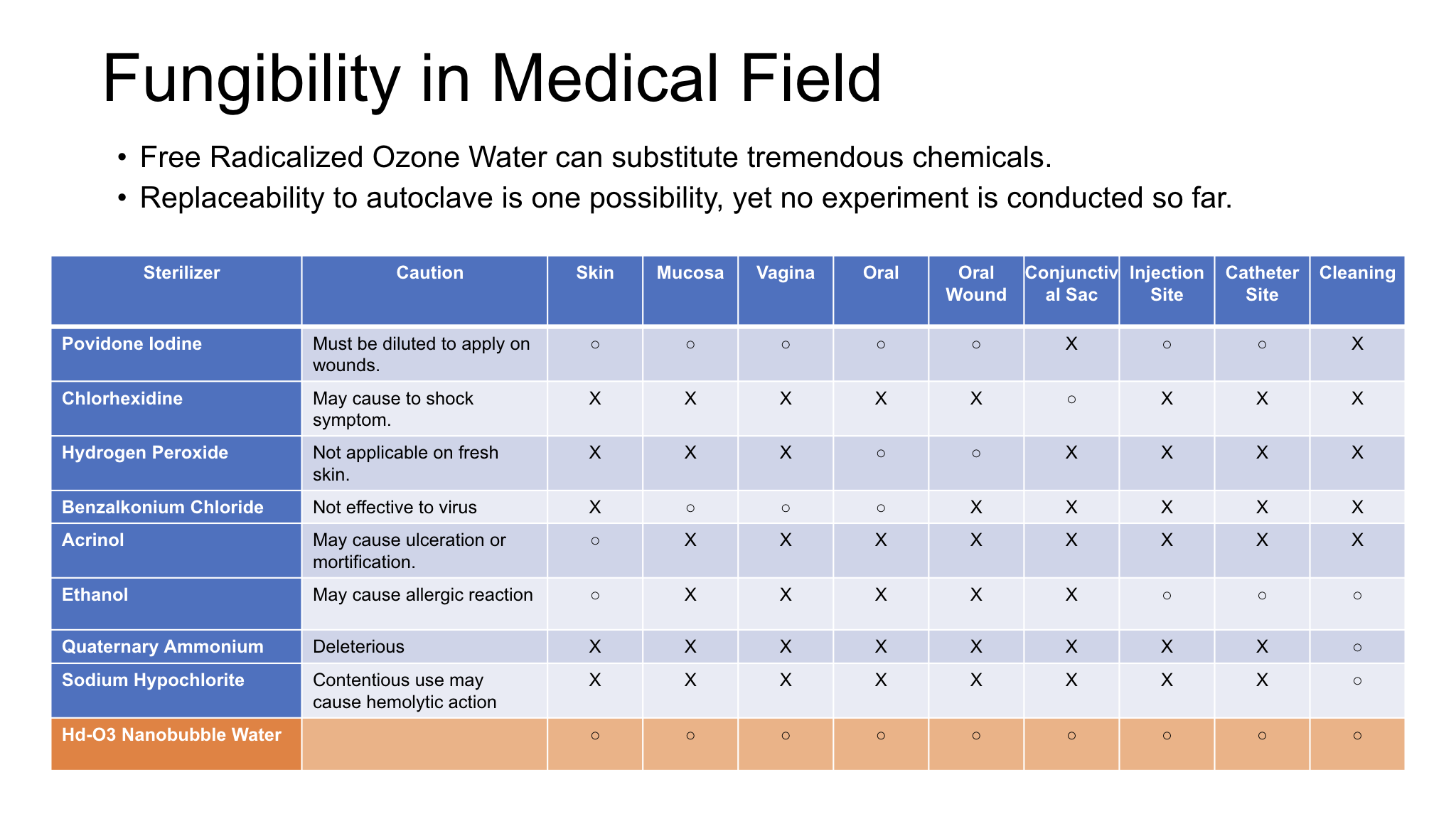
The blue section of the table represents commonly used disinfectants.
You will notice a surprising number of "Not Applicable (X)" marks and precautions.
Povidone-Iodine: While it has high bactericidal power, it requires concentration adjustment depending on the application site.
Diluting this accurately is extremely difficult when water is scarce.
Chlorhexidine / Ethanol: These are easy to obtain but cause strong irritation to mucous membranes.
They carry risks of "shock symptoms" and cannot be used on open wounds or sensitive areas (such as the mouth or eyes).
"Can I use this on this wound?" "Does the patient have allergies?"
In moments where every second counts, selecting the right drug from limited supplies places a heavy mental burden on medical workers.
Furthermore, physically stocking and transporting all these varieties of chemicals is extremely difficult.
2.The Overwhelming Strength of "One Solution for Everything"
This is where I want you to focus on the orange row at the bottom of the table: "Ultra-High Density Nanobubble Ozone Water."
Compared to the blue area, the difference is obvious.
From skin and mucous membranes to oral wounds, around the eyes, and even catheters and environmental tools, every category is marked with a "Circle (O)."
This signifies a huge revolution.
Use Without Hesitation There is no need to worry, "Will it sting?" or "Can it be used on mucous membranes?" It handles everything from treating injuries to cleaning evacuation center floors and washing instruments with just this one solution.
Extremely Low Risk of Side Effects There is no mention of "shock symptoms," "ulceration," or "allergic reactions" seen in existing drugs.
The fact that it can be used safely on anyone, from children to the elderly, is a massive advantage in evacuation centers where large numbers of people gather.
3.Raw Materials are "Water and Air." A Strength Independent of Logistics.
The greatest feature of this ozone water is that it can be created on the spot from "water and oxygen (air)" as long as there is a dedicated generator. (Note: While power and specific devices are required, the logistical hurdle is much lower than transporting large quantities of chemicals.)
In isolated areas or remote islands where traffic is cut off, there is no need to transport boxes of heavy disinfectant bottles.
As long as there is local water and air, fresh and powerful sterilizing water can be generated continuously without ever running out.
Furthermore, the table notes that "Alternatives to autoclaves(high-pressure steam sterilizers) are also being considered."
Usually, large-scale equipment is needed to completely sterilize surgical instruments. However, if ozone water can serve as a substitute, it could ensure high-level safety even in clinics or field hospitals that lack such equipment.
4.Summary: Shifting from Stockpiling "Goods" to Preparing "Infrastructure"
We need to shift our thinking from "how many bottles of disinfectant to stockpile" to "how to establish an environment (infrastructure) to create safe water on-site."
Ultra-High Density Nanobubble Ozone Water, which has extremely low side effect risks and can be used for virtually any purpose, is not just a substitute for disinfectants.
It is a "new safety net" to protect human lives and health in places where supplies cannot reach.
As preparation for unpredictable disasters and as support for remote medicine, the introduction and spread of this technology are strongly needed now more than ever.
CWM has patented original technology "Nano-Inset" which is highly capable in this medical solution as well, and looking for business partners.
If you are interested in this solution, no hesitation is needed to contact us to make a big change to society together.
Source: Data in the image is based on materials created with reference to the Kenei Pharmaceutical website and interviews with clinicians and experts.
