

Turning Concrete into a "CO2 Savings Bank"How Nano-bubble Technology is Reshaping the Future of Construction
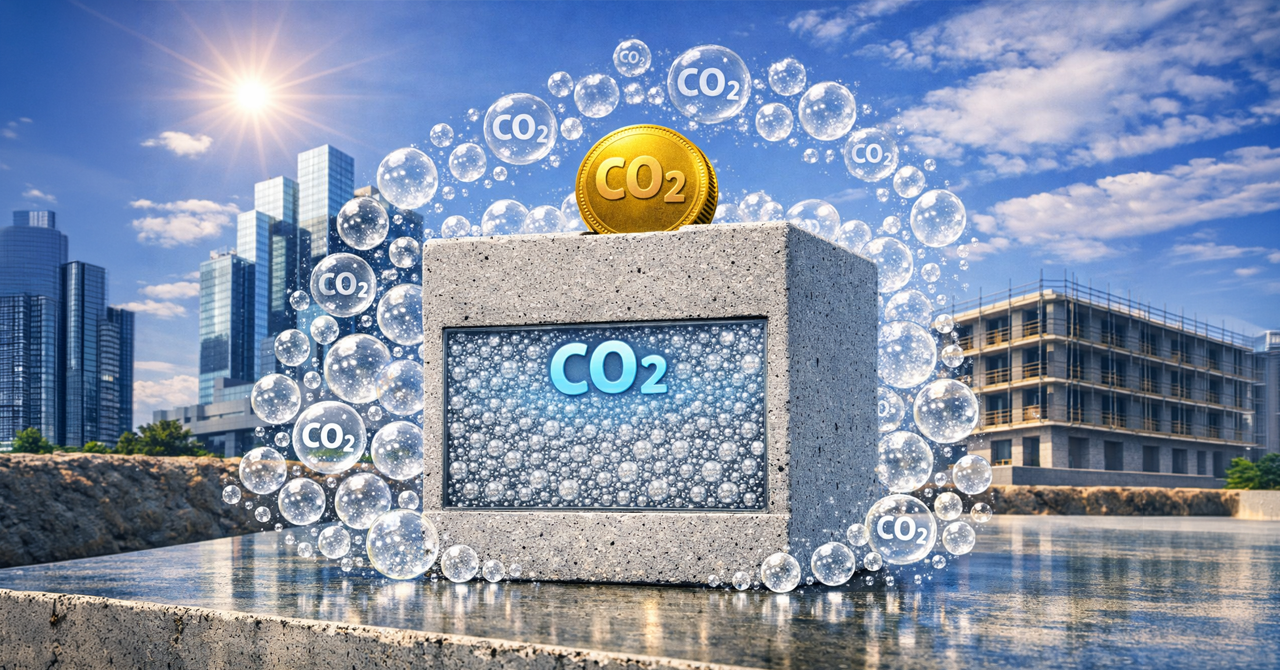
1. Cement: A Massive Source of CO2 Emissions
Cement is the primary ingredient in concrete, but its production comes with a heavy environmental price. It is said that for every 1 ton of cement produced, approximately 0.8 tons of CO2 are emitted.
To put "1 ton of cement" into perspective, it is roughly the amount needed to pave a two-car residential driveway. In other words, simply creating the materials for that small space releases about 800kg of CO2 into the atmosphere. In a decarbonizing world, reducing cement usage has become an unavoidable priority for the construction industry.
2. "Mixing in CO2" Actually Makes Concrete Stronger
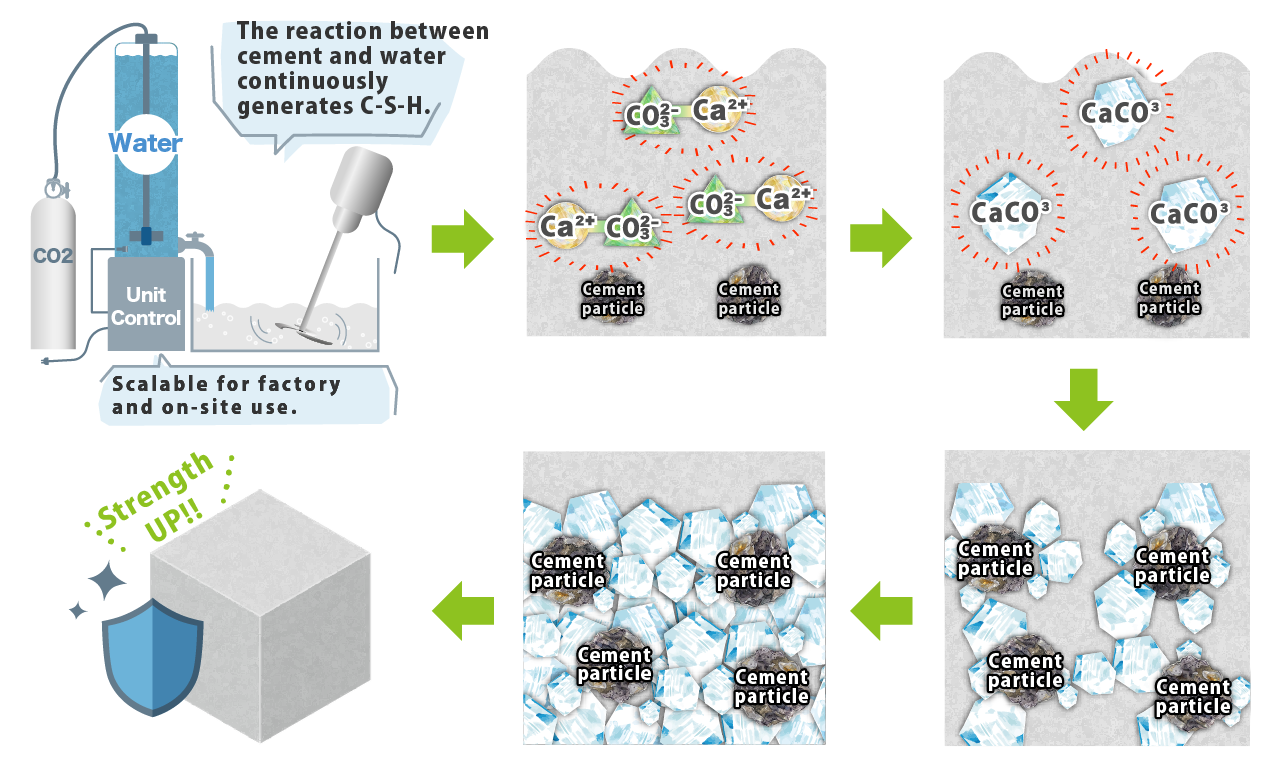
There is a groundbreaking method that makes concrete stronger by "mixing in" CO2 rather than just "reducing" it.
When CO2 is injected into the cement at the optimal timing—along with water and aggregate—it triggers a chemical reaction that generates calcium carbonate. These microscopic particles of calcium carbonate fill the internal pores of the concrete, creating a denser, more compact structure. As a result, the overall strength of the concrete is significantly enhanced.
This increased durability allows for an approximately 6% reduction in cement usage while permanently sequestering CO2 within the concrete.
This technology also brings transformative benefits to the use of recycled concrete.
Traditionally, using "concrete debris" (crushed materials from demolished buildings) as a substitute for sand tended to result in lower structural strength. However, by integrating this CO2 injection technology, the strength of concrete made with recycled materials can be substantially improved.
This enables the widespread adoption of high-quality recycled materials, simultaneously reducing environmental impact and offering a vital solution to the increasingly severe global sand shortage.
3. Eliminating Loss with "Nano-bubble" Technology

Supporting this method is Japan’s world-leading Nano-bubble technology. By dissolving CO2 into water as invisible, ultra-fine bubbles (nano-bubbles) rather than injecting it as a raw gas, we unlock unique advantages:
Minimal Buoyancy
Because nano-bubbles are so small, buoyancy hardly affects them, allowing them to remain suspended in the liquid for long periods without escaping.High Reactivity
The minute size of the bubbles drastically increases their total surface area, allowing the CO2 to react with the liquid far more efficiently.
Furthermore, the system is designed for extreme efficiency. By utilizing the evaporative pressure of the gas and the natural hydraulic pressure from a 3-meter-high water tank, the system can operate with almost zero electricity.
4. A Revolution in Road Construction (Integration with Road Stabilizers)

This technology extends beyond buildings to road infrastructure. Road Stabilizers—heavy machinery used to solidify roadbases by mixing soil with lime—can be easily upgraded. By simply replacing "standard water" with "CO2 Nano-bubble Water," we see immediate benefits:
Perfect Synergy with Lime
Lime hardens through a reaction with CO2. Nano-bubble water ensures CO2 is distributed evenly and deeply into the soil, promising faster and stronger road foundation stabilization.Seamless Implementation
Since the machine’s existing spray system can be used without major modifications, the barrier to entry at construction sites is incredibly low.
5. Creating New Value Through Carbon Credits
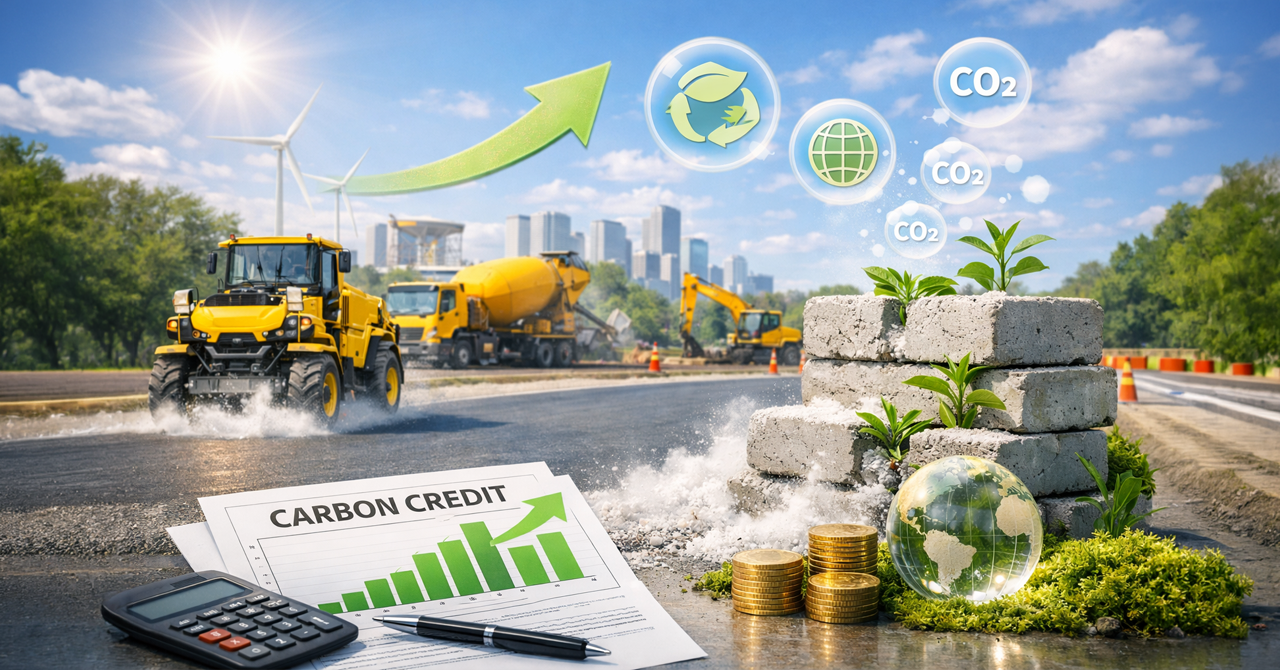
The CO2 captured within concrete and roads can be quantified and claimed as Carbon Credits. Turning environmental contribution into a measurable financial asset creates a new business model that is both "earth-friendly" and "economically viable."
Call for Partners
CWM is currently looking for business partners to join us in driving social change through our innovative "Nano-Inset" technology.
Our goal is not merely the profit from hardware sales. We aim to co-create a new paradigm of value—one that centers on global environmental contribution and the generation of Carbon Credits.
If you are interested in this vision, please feel free to contact us. Let’s reshape the future of our planet, starting from the very ground we stand on.
